

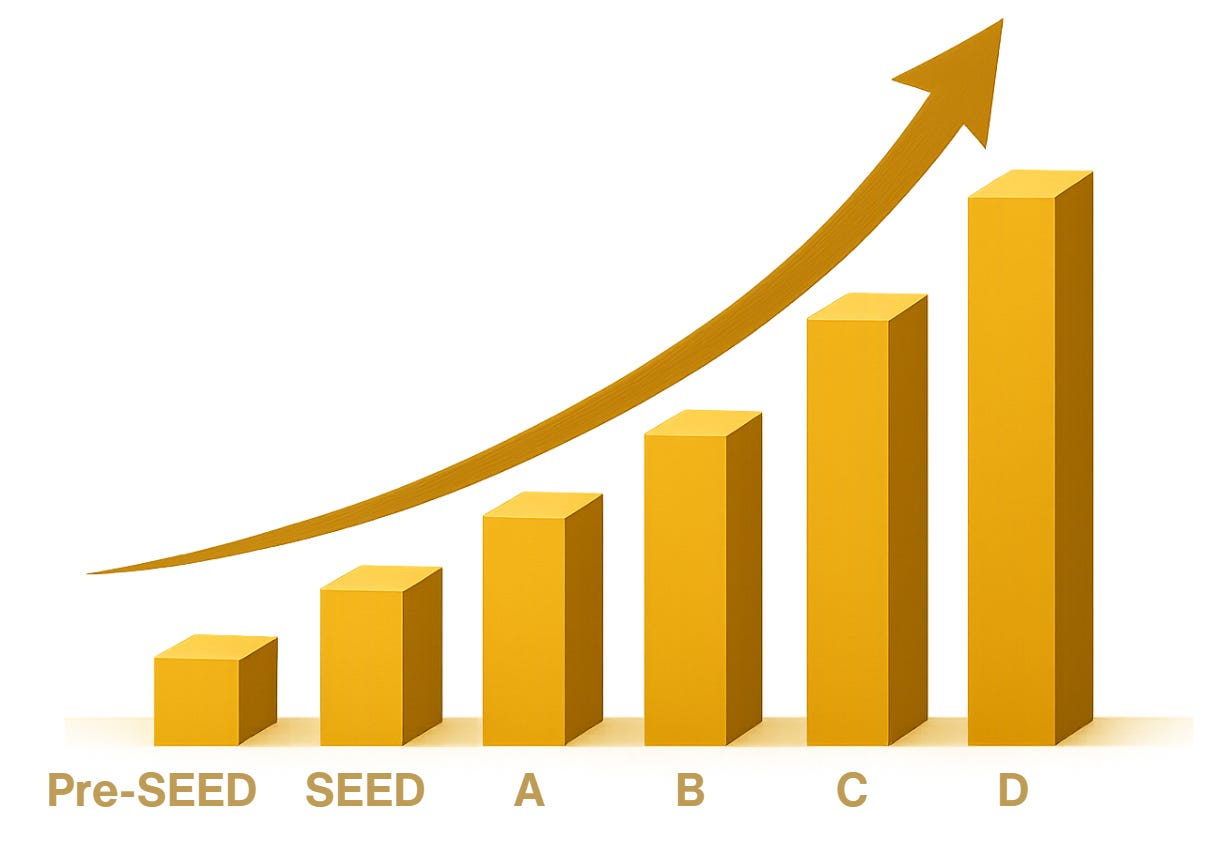
Most founders who pitch me misread the stage they’re actually in.
A founder walks into a Series A pitch with $800K ARR and a beautiful narrative about PMF. Great logos. Passionate pilots. Real usage. They wonder why every fund passes.
They think they ran a Series A process. The market treated it as a late Seed, at best.
That gap between what you called the round and what the numbers actually signal is where most raises die. Silently. No clean “no.” Just a slow fade into radio silence that the founder later rationalizes as “the market is tough right now.”
The market is not tough. The stage translation and, as a result, the founder-investor fit were wrong.
This is a perception issue, not a product issue. And perception, as I argue in everything I write, is the product when it comes to fundraising. Fundability is not a metric score. It is engineered to show how investors experience you, your numbers, and the round.
Let’s fix the translation.
The Myth of the Round Label
Founders love the labels. Pre-Seed. Seed. Series A. They confer identity. They signal maturity. They anchor the pitch.
They also lie.
What actually matters to a 2026 investor is not the letter on your term sheet. It is the bundle of signals you bring into the room:
Revenue band
Growth trajectory (MoM and YoY)
Retention quality (logo churn, NRR, gross retention)
Sales repeatability (CAC, CAC payback, LTV/CAC)
Capital efficiency (burn multiple, Rule of 40)
Runway discipline
Narrative coherence
Founder presence and category timing
A “Series A” with $1.2M ARR and 40% YoY growth isn’t a Series A. It’s a Seed bridge dressed in A clothing. No top-tier US fund will meaningfully engage, regardless of how the deck is designed.
Meanwhile, a $6M ARR company growing 180% YoY with 130% NRR and a 1.3x burn multiple could credibly raise a Series B with Series A optics, because the quality of the bundle dominates the letter.
The letter is marketing. The bundle is the truth.
The New Bar (US B2B SaaS, 2026)
The post-2021 recalibration is complete. The generous “2021 bar” is gone. What replaced it is tighter, more efficiency-aware, and far less forgiving of growth-at-all-costs storytelling.
Here is the center-of-gravity benchmark for US B2B SaaS right now. Treat it as a navigation map, not a pass/fail gate.
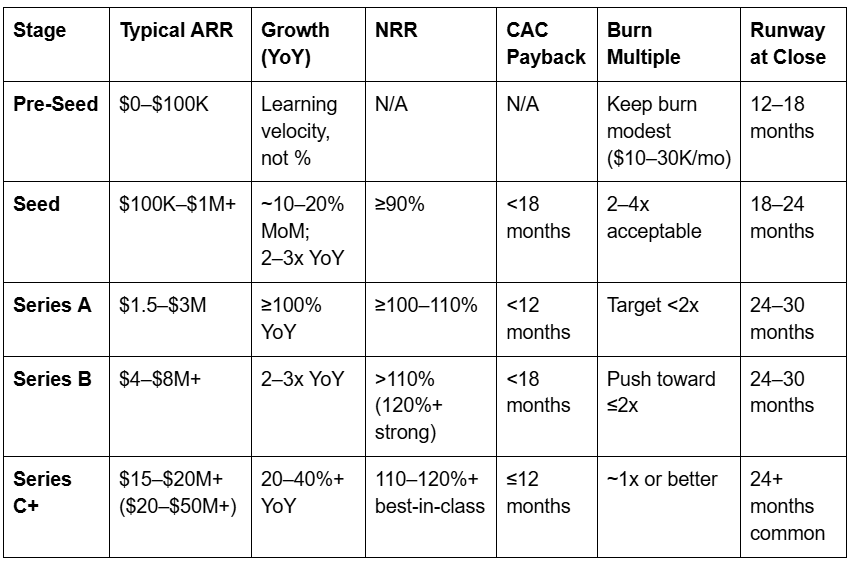
Four things jump out of this table once you stare at it long enough.
First, the Seed bar hasn’t really moved, but its entrance got harder. The “no revenue Seed” is not dead. It just requires a pedigree or a category-creating thesis that most founders don’t have. If you can’t walk in with that, you need real early traction.
Second, the Series A bar jumped. The $1M ARR “rule of thumb” that defined 2019–2021 is gone. In most rooms, you’re looking at $1.5–$3M ARR, 100%+ YoY, with NRR above 100% and CAC payback under 12 months. One of these breaks, and the deal becomes a late-Seed extension, not an A.
Third, Series B is where the efficiency religion crystallizes. Sub-2x burn multiple, 2–3x YoY growth, and 110%+ NRR is the new trinity. Miss one of the three, and you will be told to “come back when you have more efficiency data.” Recent analyses suggest that companies with burn multiples under 2.5x and 18–24 months of runway at pitch have an over 80% probability of successfully raising a B. Below that threshold, the probability falls off a cliff.
Fourth, Series C+ is judged like a mini-public company. Rule of 40 at or above 40. Expansion ARR contributing 30–40%+ of new ARR. Gross margins in the 75–80%+ band. A credible path to free cash flow positive. ARR alone is table stakes.
Caveats worth stating cleanly, because these numbers aren’t universal:
These are US-centric, B2B SaaS norms. Deeptech, biotech, and hardware trade revenue proof for IP and regulatory proof at the same stage label.
AI-native or category-creating companies sometimes compress stages. I’ve seen credible Series A rounds close at $500K–$1M in ARR in 2025 when the growth and strategic signals are exceptional. These are exceptions, and the exception narrative must be earned, not asserted.
Israeli and non-US rounds often trail US benchmarks by one quarter to one half-stage on revenue, but are unforgiving on efficiency and team depth.
Use the table as a navigation beacon. Calibrate the exception story carefully. Don’t lie to yourself about which lane you’re in.
Stage by Stage: What’s Breaking vs. What’s Fundable
Benchmarks tell you where the bar sits. They don’t tell you what to actually do. This is the layer most founders skip - the operational translation of a stage into a set of built artifacts and perception cues.
Stage 1. Pre-Seed: The Search for Proof
What’s breaking: You have a vision. Maybe a prototype. A whisper of traction. A hunch the market wants the future product. But you’re not relying on the product. You’re relying on your clarity, your insight, and your ability to see the timing and move on it first.
The trap: founders pitch the product. Investors are evaluating the founder’s mind.
What’s fundable:
A “why now” tight enough to make the investor feel late already.
A specific go-to-market wedge. No more “we’re for everyone.” A named ICP. A named channel. A named the first 20 customers.
A milestone-based raise. Not “$400K to hire an engineer.” Try “$400K to reach 3 proven use cases and $10K MRR in 9 months.”
A tone that reads as leadership, not as asking for permission.
At Pre-Seed, “metrics” mean something softer: pilot commitments, design partner logos, usage density inside a small cohort. One meaningful pharma design partner is worth more than $30K of transactional ARR from strangers. One benchmark dataset places the median pre-seed MRR at around $1K and the median ARR at around $26K, with only ~27% of companies having any revenue at all. You are not behind if you have nothing. You are behind if you have nothing and no compelling why-now.
Stage 2. Seed (~$2–5M raise): The Race to PMF Signals
What’s breaking: Traction exists, but it’s scattered. Investor calls lead nowhere. Metrics lack depth. The raise lacks urgency. The cap table is cluttered. The founder is pitching without a system, chasing interest rather than building momentum.
The trap: Seed founders treat fundraising as a series of meetings rather than a launch.
What’s fundable:
Traction that shows repeatability. The same ICP closing via the same motion more than three times.
Clear signal that the market is pulling (inbound, organic signups, unprompted referrals).
A raise structured like a launch - dated, scoped, allocation-mapped. Not rolling. Not vibes-based.
A founder-led 12–18 month plan that reads as a plan, not a wish list.
Deck, digital presence, founder story, and outreach cadence aligned as one system.
Healthy 2026 Seed metrics: $100K–$1M ARR, 10–20% MoM growth, <5% monthly logo churn, NRR trending toward 90%+. Gross burn $50–$120K/month, team of 4–10, with 10–25% of spend already touching sales and marketing. Not “all engineering.” The GTM seed is already planted.
Stage 3. Series A: Proof of Repeatability
What’s breaking: Founders show promising traction but still talk in experiments. Investors want 3x growth signals. The story reads like a continuation of Seed, not the beginning of scale. Everyone senses the team is running hard without a system that can triple.
The trap: Series A is not “more Seed.” It is a categorically different pitch. Your Seed deck will get you politely declined at an A.
What’s fundable:
Metrics that prove go-to-market fit — not just PMF. Sharp CAC, healthy LTV/CAC (3:1 or better), CAC payback under 12 months.
NRR at 100–110%+. You’re at least offsetting churn. Ideally, expanding within the base.
The company looks ready to triple, not just “grow.”
A raise structured like a launch, with the same principle as Seed, higher production value.
A clear portfolio view: ARR by segment, motion efficiency, and headcount plan. All mapped to the next 18–24 months.
Series A in 2026 is being priced around $1.5–$3M ARR, 100%+ YoY, with burn multiple targeted below 2x. Typical raise: $8–$20M, with 24–30 months runway. Median gross burn $200–$400K/month, team of 20–35, with sales, marketing, and CS fully stood up.
If your burn multiple is 3x, you don’t have a fundraising problem. You have an efficiency perception problem, and it will be priced in as a discount or as a pass.
Stage 4. Series B: Proof of Machine
What’s breaking: Revenue is growing, but margins are thinning. The company is scaling faster than its infrastructure can support. What once looked like momentum now feels like noise without operational discipline. Churn is creeping up. Leaders are context-switching. The org chart looks improvised.
The trap: founders pitch “growth” when investors are evaluating “system.”
What’s fundable:
Predictable growth, driven by systems, not heroics or founder-led deals.
Every new dollar of capital multiplies what’s already working. No “experiments” at B.
Headcount scale tied to process maturity. New hires slot into defined playbooks, not vacuums.
Fundraising materials that shift from story to strategy: operating plans, cohort breakdowns, GTM efficiency maps, ARR per employee.
Series B is positioned as the unlock for enterprise scale, category dominance, or multi-product expansion.
The new Series B bar is $4–$8M+ ARR, 2–3x YoY growth, NRR north of 110% (120%+ is where premium multiples get justified), CAC payback under 18 months, and burn multiple trending below 2x. Rule of 40 becomes a centerpiece metric here. Companies consistently above 40 command valuation multiples 2–3x higher than those below. That single ratio is often the difference between a flat round and a priced-up round.
Stage 5. Series C+: Race to Outcomes
What’s breaking: The company is large, but bloated. Growth is expensive. The narrative is unclear. Investors are no longer asking “how fast can you grow?” They’re asking, “How will this end?” CEOs leapfrog. Capital is raised to survive, not accelerate.
The trap: C+ founders keep telling a growth story when the room wants a dominance and exit story.
What’s fundable:
Growth that is efficient. Burn is intentional. Unit economics are optimized. ROI is legible.
Every dollar raised is mapped to an outcome: a market, a geography, a product line, or an acquisition.
Narrative shifts to category dominance and exit pathways: IPO readiness, strategic acquirers, durable moat.
The founder plays a portfolio-level role: a capital allocator, a category shaper, and a talent magnet.
The raise itself is positioned as a strategic advantage, not a survival mechanism.
At C+, you are being judged like a public company. Rule of 40 ≥ 40–50. Burn multiple compressions toward 1x. Expansion ARR contributing 30–40%+ of new ARR. Gross margins north of 75–80%. A credible glide path to free cash flow positive.
The Perception Gap
Here is the thing most founders miss: the metrics above are necessary, but not sufficient.
You can hit every benchmark in the table and still not raise if the perception doesn’t hold.
Conversely, you can miss one or two benchmarks and still close a round quickly if the bundle of signals creates conviction.
Investor conviction is not a data problem. It is a perception-engineering problem.
Five things create conviction in the room:
Category coherence. The founder names the category with authority, and the named category is one investors want to be in.
Founder presence. The founder shows up as someone investors follow, not someone they evaluate.
Narrative momentum. Every data point reinforces a single arc. No disparate facts. No “and also.”
Deal architecture. The round is designed, not assembled. Lead, allocation, terms, timing, and social proof all choreographed.
Metric stack fluency. The founder doesn’t recite metrics. They tell a story through them.
You can hit the number and still miss the round. The number is the floor. The perception is the ceiling.
How to Read Your Stage Honestly
Before you name your round, answer these five questions. Write the answers down. No negotiating with yourself.
Which benchmark band am I actually in? Not the one I wish I were in. Not the one I can spin. The one my numbers objectively show.
Where am I strong on the bundle? ARR? Growth? NRR? Efficiency? Which two are my hero metrics?
Where am I weak relative to the bar, not relative to last quarter?
Is my weakness fixable before the raise, or is it a reposition-the-round problem? Sometimes the fix is “add two quarters of data.” Sometimes it’s “call it a Seed extension, not an A.” Those are different playbooks.
What is the perception gap between the round I want and the round I can run? Close the gap with a system, or run a different round.
Founders who answer these honestly raise faster, with less dilution, at better terms. Founders who skip them end up with 60 nos and no diagnosis.
Prepare One Stage Ahead
The single best strategic move I give every founder I advise:
Manage the business today to the metrics the next round requires.
If you’re at early Seed, manage burn, GTM, and NRR such that by month 18, you can plausibly hit the Series A bar.
If you’re at Series A, start building the systems and data room today that a Series B lead will expect in 18–24 months.
Fundraising is a lagging indicator. The round you closed today was actually won 18 months ago in the decisions you made about focus, burn, ICP, and storytelling.
Bottom Line
The letter on your term sheet is a label. The bundle of signals is the truth. The perception is the product.
Most founders raise at the wrong altitude because they confuse the label with the bundle, the bundle with the story, and the story with the perception.
Engineer all four in sequence. The growth follows.
If this article was useful, share it with one founder who’s about to raise.
— Leon Eisen, 4x Founder, Venture Capitalist, and Creator of Fundables OS™